03
Oct 10

Will The Kinect Connect With Gamers?

The latest  trend in console gaming as of late has been the use of motion technology. Started by Nintendo with the Wiimote , competitors Microsoft and Sony are set to launch their own iterations this fall  of how they plan to allow gamers to interact with games in the months and years to come.

For the past year+ I’ve been following Microsoft’s product entry originally called Project Natal and now called the Kinect. Starting with the presentation  of the Milo project  during E3 2009 I definitely got chills and came to  think that this technology had some major potential ( See  the video below to see what I mean!)

1 year passed from the release of the project Milo video and I didn’t really hear much further about the Kinect until this summer from E3.  The thing was that  there was no mention of Milo, instead there were  announcements of games such as Kinect Adventures and and Kinect Joy Ride. Essentially games aimed towards the casual market  that looked like they were taken from the Wii. After being shown such a great tech demo this was hardly anything ground breaking. Another aspect which shaked my confidence a bit  in the machine  was the discussion from reporter previews making mention of significant play lag when using the Kinect . Would the Kinect not meet its full potential and just turn into a Wii wannabe device?

Recently I checked out the Toronto Kinect preview put  on by  Xbox Canada. Getting to try the system hands on (or hands off really) would finally help me to determine if this was a peripheral that would withstand the lifespan of the Xbox 360 or be eventually discontinued (much like the Xbox HD disc drive).

What are my thoughts on the Kinect now having played it? There is some serious tech behind this machine but its still early days. Getting to try most of the game demos on display I had to say except for Kinect Joy Ride the control of the games were very tight and the game play was fun. I wasn’t experiencing any sort of lag and my in game character was mimicking my every move flawlessly. Being shown a device tool (shown in the picture below) you could see that the Kinect was essentially a motion capture machine and more. When showed another Kinect tool I was amazed to see the level of detail in the image it was displaying back to me. In a pixelated view of myself even smaller details like the writing on my sweater were being displayed.
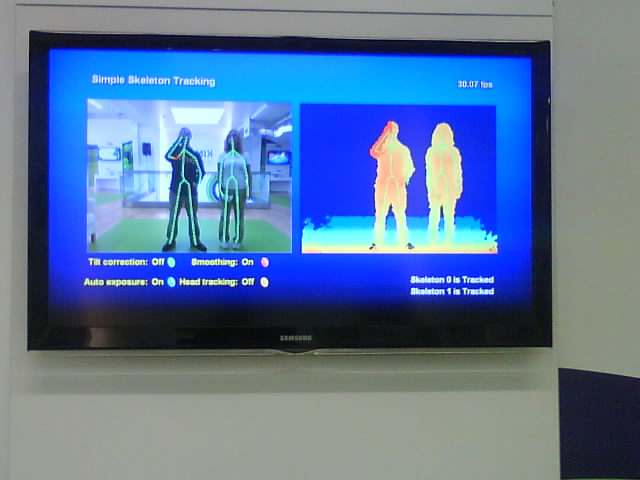
More than just motion capture!

My concerns for the system? That it will be nothing more than a tool to attract casual gamers pushing out games that contain just short mini contests and family trivia. While it has been confirmed that Fable 3 will have some sort of conectivity and at the Kinnect preview I was assured that they had more in depth games in the works, Microsoft needs to get a few blockbuster quality games on the Kinect for it to be accepted by their primary audience who play games like Halo, God of War and Madden NFL. If they can get games out  with similar game play to the commercial below I’d be completely sold!

While to a smaller extent, I was also concerned by the demands of the Kinect in terms of how much space and energy it required to play this game. In one demo, I found to be successful in the game I needed to be moving in a floor area that if played in my apartment  would place significant demands on my  living room space.

The games  also if played for long periods are definitely a workout ! They aren’t ones you can simply sit down for, they take your whole body and movement into it. As gaming is often something people  play to to sit back and unwind,  being required to be on their feet and active may be a bit of a put off.

Overall I’m converted back into thinking that the Kinect will be a killer app for the Xbox 360. I hope that Microsoft is able to put the marketing push into this device and persuade gamers to purchase it as I know I will!

20
Sep 10

Do you want Foursquare with that?

The most important concept in social media marketing that I’ve learned is that for efforts to be effective they should be connected to how the firm earns money. Having fans and creating engagements is great but when it’s not driving firm revenue in some way, shape or form it’s not useful.

That’s why when I read Mashable’s recent article about the McDonald’s head of Social Media Rick Wion celebrating a 33% increase in Foursquare check ins with a pilot program they ran I was disappointed that there wasn’t more to it. While the goal was apparently not to increase sales immediately this campaign could have been much cooler in seeing if McDonalds actions actually created an increase in sales( or not…).

How McDonalds could have measured the campaign (if they had wanted to):

McDonalds could have easily done one of two tests to see if this campaign was effective. First and probably most easy is that they could have just compared sales and check-in results from previous days for an extended time period to see if this 33% increase in check-ins actually led to an increase in money into stores. If revenue saw a significant jump when foursquare activity spiked (barring other variables) Mcdonalds would have at least some proof to try the campaign again.

The second test is running the campaign on a smaller scale comparing it between two similar markets. One would run the Foursquare campaign and the other would have no promotions. In the end, sales and check-in figures would be compared between the two. If the market with the Foursquare campaign saw an increase in check-ins along with revenues in comparison to the control market McDonald’s could further test this campaign and have it rolled out on a larger basis.

While I don’t know the full goal of the McDonalds Foursquare campaign I feel that despite the celebration within the Mashable article it’s still important to clarify that social media in business is not successful by engagements alone. If I would go on twitter or another network and tried giving away something for an audience action people would have jumped on it as well. In the end social media campaigns need to be attached to financial drivers because most companies can’t operate on foursquare check-ins alone. ;)

Do you have a question or comment ? Feel free to reach me at @kevrichard or kevin@kevrichard.com


11
Aug 10

SXSW 2011: Canadian Panels To Vote For

Its that time again! As last year’s post showing the many Toronto (and eventually Canadian) panels up for voting was such a success I decided to give the list another go this year with the goal again to try to get as many Canadian Panelists into SXSW 2011! (And to make peoples dreams come true ;))

Find below an initial list of people who have submitted their panels up for review. This post is open to everybody, if you know of someone or have your own panel that you would like to submit feel free to @me on twitter or send me an email (kevin@kevrichard.com)

THE LIST:

And theres more! Came across this great listing of Vancouver SXSW sessions on Tech Vibes. Not to take away from the awesome work done in creating the profiles you can check them out and vote for them HERE.

I know there are many other panels out there so folks let me know if you want your session up! For those coming across this post please support these adventurous folk share what they have to say in Austin this spring at SXSW.


08
Aug 10

To Do: Be Part Of A Web Series

For the past few years I’ve been following the web series The Guild and went through the joy and pain of the sporadic rate the content has been posted. The web series follows the experiences of lead character Codex and her experiences with her World of War Craft guild, The Knights of Good.  In its 4th season this series gives you a look at the collision  the guild experiences between in game interactions and real life .  A mixture of video game culture and awkward humor, what can I say its a guilty pleasure! (Check out Episode 1 here)

Looking at the concept of the democratization of content web series are a growing divergence from normal media (television,movies) we are used to. As online video is allowed to get larger  this will further provide the general public with more choice. Essentially watch out big media companies you have competition! Looking at the success of The Guild (boasting more than 50 million views) this competition has the potential to get big!

I think everyone at some point in their life gets the dream that becoming an actor or working in film would be great. Hollywood I’m sure is full of aspiring actors and  sadly has been a place for many crushed dreams.With Web content, essentially anyone with a camera and an idea can do it! Which on one side makes things less glamourous but on the other opens up the film industry to essentially anyone who has talent.  For myself I don’t know if I have the skill for being in front of a camera (some say I have a face for radio!) but I think being involved in the process of content creation be it conceptualizing it, being part of the writing and even doing the filming would be something interesting to be involved in.

What about the Money?

So how does web episode content bring in money for its developers? Much like with regular television web content is supported primarily with advertisements but some also make money off of merchandise . The system varies on the video hosting site but with Youtube suitable content that gains enough views is eligible for a portion of advertising revenue that the site gains through banner advertisements.  Essentially its all about the hits and how much of an audience you can pick up.

Avoiding the one man show:

Unless you have a bunch of friends that are as gun-ho as you are about starting up a web show,  finding the  talent or becoming involved in a semi established group of creators can be difficult. One option in the search for your next web episode crew is a site called Spidvid a social network that brings together content creators to get stuff done! I can across this startup in its early stages late last year and as of right now has a fairly active community(check it out!). Otherwise like any sector of the public interested in one topic or hobby you’ll have to go out and find out where these similar minded people are/hang out and start meeting them and sharing your ideas. Nobody said starting something new was easy!

For myself I hope to keep this in mind as something I want to get involved in (even briefly) to have some fun with and to overall create cool content! With web video growing like it is I think its a great chance for people to be creative and test ideas. So…. if anybody wants to brainstorm a web show let me know!

In ending  feel free to reach me at @kevrichard or kevin@kevrichard.com

BONUS CONTENT!! Who said I only enjoyed one web show?! For another good laugh be sure to check out ” The Legend of Niel” (Warning: NSFW…. the comedy in this one is a bit more crude but fans of old school Zelda should get a kick out of it! )


02
Aug 10

Our Privacy Online

For a while I thought that internet privacy was over. The era of your mom telling you that  you shouldn’t talk to strangers and to keep your identity a secret was coming to an end.  I kept the mind set that the internet has become just another facet of a person’s identity and that information you post up is similar to being part of a phone book or walking down the street. Recently there have been a few things which made me reflect upon  how internet privacy and anonimity on the web still has some importance.

Blizzard Vs. The Hordes:

Earlier Blizzard Corp makers of World of WarCraft, Diablo and Star Craft announced the implementation of a RealID system which they planned to put into place for the upcoming Star Craft 2 title and later across their entire library of games. The idea behind real ID was that users could interact and be more connected to their friend lists within these games.  Blizzard had to later pull back on this initiative  because of the massive backlash from their communities and it is now  an optional feature rather than being  enforced system wide.

When everyone has a Facebook account why would gamers be concerned about revealing their personal information in game? Well for some its a sense of escape, it takes them away from their day to day lives as described in an editorial from Daniel Lipscombe  titled Why I play games: My Escapism . Gaming is a way to become separate from day to day activities. If you attach your real name to characters in game or within discussion of the game  is that separation still there? Also if  a character named “Princess Peach” decked out in pink  is suddenly attached to a user named Joe Blow can this person still act out the characteristics of that character? (Ok extreme example but you get the point!)  Despite all of this openness on social sites such as Facebook,  anonimity is still sought in the gaming world because once you form your character you can be a different person than yourself. When that character suddenly has your name it changes that aspect of the game.

The Anonymous Internet

With the ability to act (almost) completely anonymous online a certain mob mentality can often sink in within a group of like minded users sometimes with negative consequences.

Jessi Slaughter  AKA Kerligirl13 an 11 year old  from the U.S. enjoyed sharing her life and her interests on YouTube like many vloggers. As video views increased on her channel she began to see negative comments and she reacted much like any 11 year old girl would with a reactionary video. This video to haters  with the infamous line “I’ll pop a glock in your mouth and make a brain slushy” went viral and attracted the wrong type of attention. So much so that her and her family are now under police protection .

A large cause of this problem  is a site called 4chan. Now I won’t go into much details about the site or its users (because they scare the hell out of even me…) but as a group they have been known for creating false rumors about Steve Jobs having a heart attack (and causing Apple stock to take a tumble) and rigging the Time Magazine 2008 most influential person poll to be Christopher Poole aka Moot the founder of the site. Essentially this site with its large and anonymous user base is able to cause a lot of trouble when motivated to do so.

Upon seeing the video from Jessi ,4chan users decided to take it upon themselves to teach this girl a ‘lesson’ through harassing phone calls and  vandalism of social media profiles among other things. While what this little girl has said online is  absolutely inappropriate for a girl her age to be saying at all, harassing her and her family is even worse. With the growing ease of finding personal information online it is easy to announymously contact another person and do actions to them to the point of harassment. Kids especially not knowing the expansiveness of the internet and the consequences of being online are now increasingly at risk of receiving abuse online and without fully understanding could be sharing all sorts of personal information with perfect strangers on the web.

With younger age groups being at such risk online its very easy to say that they should be protected but the harder thing to answer is how?  No matter what restrictions are put in place there will be work arounds. Age restrictions on sites are easily lied to and  parental controls are almost easily turned off as well. When others can act anonymously and manipulate your own information how can be protect those who are just learning about the full expanse of the web?

Creating Online Persona’s

In the end I think managing your online self is becoming just as important as managing yourself offline. We all are visible online, its as easy as a quick google search so we need to ensure that only what we want people to see is visible. I think we also have to remember that our anonymous selves aren’t completely anonymous either. Comments or accounts that you think you made in private  can still be potentially tracked back to you.

Having these online persona’s bring on new problems like cyber bullying and identity theft and for good and for bad put us in front of a more global audience. For now I’ll remain more careful of what I place online and will continue to watch how things develop.

Do you have a question or comment ? Feel free to reach me at @kevrichard or kevin@kevrichard.com


25
Jul 10

Announcement: Blog Redux

Yikes,its been since the end of April that  I wrote something on this blog… truthfully thats a little embarrassing! Its not that I dislike writing its just with my current format I don’t have anything to say… right now with so much content about social media going out  and not much in terms of change within the area theres not much content  that really gets my brain going.

So then what? Am I going to let this blog die?  Absolutely not, its just going to change format! What’s going on in the world of tech ( Interactive, Web and Consumer products) still really gets my gears going so I’m going to work and have that become the much more dominant content of this site. Thats not to say that I may slip in a post or two about Social media as from time to time I may come across or work on some really awesome stuff  but its no longer going to be a  focus ( just to worn the 5 or so people that are actually still reading this!).

In the next few weeks expect some changes to show up. If I can get things up and working I’m hoping to get some custom theme work in and probably a change in name and domain. In the end I think if I want to keep this blog up and running its got to come down to passion and having a bit of fun with this thing. Stay tuned!!


29
Apr 10

A Framework for Social Marketing Analytics

Like with everything that is done in business, it has to be done for a reason or else it’s just wasted effort. Measuring simply anything from your social media initiative without a reason behind it is just that – a wasted effort. In reading “Social Marketing Analytics” by John Lovett and Jeremiah Owyang this point is further proven. In measuring social media what you measure needs to be attached to specific business goals, not measured just because the number is available.


The paper by Lovett and Owyang starts off with a good definition of what Social Marketing Analytics is (what can I say I like when things are plainly defined):

Social Marketing Analytics is the discipline that helps companies measure, assess and explain the performance of social media initiatives in the context of specific business objectives.

Pay particular attention to the last part – “…in the context of specific business objectives.” What did your social media initiatives achieve for your company? Social media measurement is not just looking at the numbers of fans go up or down (or whatever shiny number there is out there) but looking at the end result of what your work achieved for your organization. Very simple but great stuff.

Lovett and Owyang write about a three layered approach to Social Media Measurement, which I feel is effective in further demonstrating the need for measurement:

1. Strategy: The reason behind the initiative.

2. KPI (Key Performance Indicator): What the measure of success or failure is with this initiative.

3. Granular Metrics: The information or inputs that need to be gathered to allow you to formulate the KPI.

Social Marketing Analytics Framework

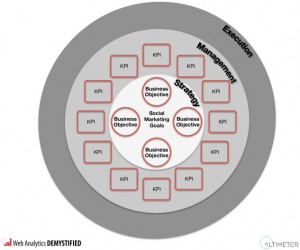
In keeping the paper accessible to general business practitioners Lovett and Owyang present four major strategies (although they mention that there are more) along with suggested corresponding KPIs. I’ll leave the KPIs for more in depth reading in the paper but I thought I’d present the strategies as these apply to many businesses:

1. Foster Dialog: Developing conversation around your company or brand. This is the development of content to create interest in what you’re trying to achieve.

2. Promote Advocacy: The development of ambassadors for your organization. Encouraging people to actively discuss and promote your brand online.

3. Facilitate Support: Provide a channel where customers are able to get their problems/concerns addressed in a timely manner ( Ex: @Rogershelps or @Toronto311).

4. Spur Innovation: The development of active discussion around your brand or initiatives focusing on the topic of improvement. Essentially putting like minds together online in developing ideas to make things better.

Overall in reading this paper it really puts it out there that:

A: Knowing what you want to achieve with social media is important and,

B: Measuring your progress (and not wasting your time) needs to be followed right after.

I really encourage you to check out the paper as it’s a great first step in developing a measurement program. I would also add that while it’s a helpful framework, it’s not a complete instruction guide. Measurement, like any other business initiative, needs to be scaled and customized to fit with the specific organization. Measurement and tools that apply for a large multinational corporation don’t have the same effectiveness for a smaller, local business.


22
Mar 10

Are you learning anything from Social Media?

So I’ve been procrastinating with posting this for a bit , but now I think I have a good intro…. So at my new job at Syncapse, I do a lot of measuring and spending my day looking at client data.  I’m finding it  really exciting because essentially I get paid to do the learning for companies so they can consistently improve their Social Media strategy. Reflecting on the work I do though it seems for a good portion of the ‘social media world’ that metrics and measurement and the whole idea of ‘learning’ from what you’re doing doesn’t get talked about a whole lot. With that, I thought I’d put down a few of my thoughts of why Social Media measurement or the idea of ‘learning’ within Social Media strategy is so important.

You Get To See if Things Work: With Social Media measurement you get to gauge how effective online strategies really are.  Are there no conversations surrounding your content? Is  there conversation but not the kind you want to hear? Then there is obviously something that needs to be fixed. Perhaps you haven’t told your audience about your initiatives or maybe your content isn’t relevant to them. By implementing strategies and comparing them to what you’ve done in the past  you are able to see what you’re doing right or wrong and how to make things even better moving forward.

You get to see if customers love/hate you (and how to improve it!): As a part of online measurement you are able to look at  what people are saying about a company or organization online .  This is looking at what users are saying directly AT you or what they are talking indirectly ABOUT you with everyone else.  Are they having problems with a particular product of yours? Is there something that people want to see more or less of from you? The insights you get from conversations are way different than what you can get from a survey  or traditional market research. In a survey people have time to consider and alter their answers to give you just half truths. Within online communications you’re getting the raw knee jerk reactions regarding what they think about you and how they use your product in everyday life.  ( CAVEAT: Watch out for Trolls! No matter what you do there will be someone looking to stir things up…. all I can say is DONT FEED THE TROLLS )

You Find the Unexpected: Often times its important to stick your head outside of what you’re doing to get a different perspective of what is actually happening with your company. This is especially true with Social Media. By looking at what occurs outside of your organizations’ initiatives every once and a while you may  see surprising things happening with your customers that you haven’t heard of. Perhaps they are re-purposing your product in a way that you didn’t think was important (ex: Coke and Mentos blasters) or maybe some previously unreleased news about your company has become public and is gaining an unexpected amount of traction with your customers. By learning what your customers and the public is doing ‘out there’ you’re able to adapt to things as they come up rather than let events plow you over!

In closing while a lot of discussions regarding social media surround  customer engagement and use of the tools, I think measuring your success and learning from what you’re doing online is just as important. Without knowing what you’ve achieved and what is occurring out in the wilderness that is the ‘internet’ you’re only going to continue making the same mistakes and not improve upon yourself.  With my new position in  Measurement Science I hope to be able to share some  brief tidbits  about online measurement and why its a useful part of the campaign process. Stay tuned!


13
Mar 10

Geurilla Analytics Simplified

I think now is a good time to bring up this follow up post to the recent Geurilla White Paper posting. I’m sure for some, looking at the paper was an immediate shock of words and numbers! I hope in this small version there’s a bit more understanding of what the paper tried to get across.

So whats this paper about? Social Media Measurement and the common use of machine sentiment engines as a way of measuring effectiveness….. or how un-effective this is based on the research we’re presenting. Getting right down to the point, language is COMPLEX! Thats to say that the words and messages we share with our friends are full of double meanings, slang and one of my personal frustrations lack full context. I’m sure most people have had online conversations where you’ve had to defend what you’ve said as it was read in the wrong way.

Knowing that online messaging is really complex, often times in measuring the success/failure of social media initiatives   firms use a sentiment engine to rate mentions of their brand on a scale of Negative, Neutral and Positive. With this in mind, we the Syncapse Measurement Science team looked to see if this was an a reliable measure.

What did we find? That again language is complex and no two people will perceive a set of  messages the same way.

This research was based on an earlier survey we released on twitter  where we asked  people to rate a set of 20 messages ( all taken from a twitter search for ‘books’).  The most significant finding of this survey is the lack of agreement on the survey as a whole. With such a simple answer set  we did not find  a single pair of respondents (out of 102) who could agree on the sentiment of these messages.

To put a further test in our survey we also put a wrench in the works with a trick question. We decided to repeat a question. While a majority of people rated sentiment of this question the same on each response,  19% didn’t!  So in a span of a few minutes a person’s feelings about a message can change [ meaning you have to be particularly careful in how you time your emails! ;) ]

What in the end do the findings of this paper mean? Well to quote directly  from the paper:

If a group of 102 humans could not agree, how can a single machine output a single score that everybody would agree with?

The current sentiment score system that’s in use isn’t netting  information that should be depended upon to make real business decisions. Language is just too complicated for a human programed machine to define the sentiment of social media messages.

But WAIT there’s more! If current  sentiment scores should not be used in decision making then what should be put in its place? Well I know a team that does some mighty fine work in social media measurement ;) …..  Ok,  so there’s ALOT to measure in regards to social media measurement and no one has yet created the gold standard. As an emerging industry, measurement is still playing catchup to everything else currently happening (which keeps things interesting). What we could agree on with things as they currently stand  is a more pragmatic approach, looking at the measures and feedback that is important to a  brand( or ‘Brand Health’). This means looking at the overall online communications about a  firm and determining what aspects of these activities are most important to have knowledge of.

Have any questions/comments ? Contact me at kevin@kevrichard.com or send me a twitter message .

PS: I know I’ve been on a massive blog hiatus, I’m looking to change this ASAP!


08
Mar 10

A Guerilla Experiment In Sentiment Analysis

As tweeted a few weeks ago the Syncapse Measurement Science team put together an experiment on sentiment analysis. Here is the final result of this research:

Syncapse Sentiment Analysis White Paper

and the data set for those interested in looking at the data collected

Geurila Analytics Data Set

Feel free to leave a comment or give me a tweet @kevrichard .